Feeds:
Posts
Comments

We’re pleased to announce that the summer issue of Rethinking Schools magazine features a special forum with three perspectives on edTPA, the high-stakes test for new teachers that is being piloted in teacher education programs around the country.

V27-4

We know edTPA is an issue of great interest to everyone in the field of education as we consider how best to maintain teaching as a profession.

In that spirit, we invite you to read the articles and join the critical conversation about edTPA in the comments section of this blog post.

We also invite you to consider donating or subscribing to Rethinking Schools if you don’t already do so.  Because we feel so strongly about the need for education and reflection on the edTPA, we opened up the majority of this issue to nonsubscribers, but as a nonprofit independent publisher, we rely on your donations and subscriptions to keep us going.

Thanks for reading, donating, subscribing, and supporting critical conversation.

Sincerely,

The staff and editors at Rethinking Schools

The articles in “A Forum on the edTPA”

Linda Darling-Hammond and Maria E. Hyler argue that the edTPA will lead to better teachers and more professional respect. Their article is titled “The Role of Performance Assessment in Developing Teaching as a Profession.”

In “Wrong Answer to the Wrong Question,” Barbara Madeloni and Julie Gorlewski disagree. The edTPA distorts the teacher education process, they say, and opens the door to Pearson reaping more profits and power.

What’s a Nice Test Like You Doing in a Place Like This?” by Rethinking Schools editor Wayne Au, puts the discussion in the context of corporate education “reform” as he shares his experience with the test in his own teacher education program.

Below we preview our Action Education column from our Summer issue, about the massive school closings in Philadelphia. Helen Gym, a Rethinking Schools editor, is a parent and long-time activist in Philadelphia who has been one of the leaders of the movement to save public schools. On June 7, after the magazine went to press, the district announced a staggering layoff of 3,783 employees. This will only further devastate the public schools in Philadelphia and fuel the fires of privatization and corporate education reform. We’ve included some resources and links at the end of this post to help you stay up-to-date with the fight to save public schools in Philadelphia–and across the country.

School Closures Rock Philadelphia

by Helen Gym

HelenGymThis spring, the School District of Philadelphia vot­ed to close down 24 schools, about one in 10 pub­lic schools, affecting nearly 10,000 students across the district. The vote followed months of protest and community opposition, and was backed by Demo­cratic party leadership in the city, primarily Mayor Michael Nutter—co-chair of the U.S. Conference of Mayors—and by newly sprouted nonprofit organizations focused on school “transformation” models.

The district’s push to close schools, in classic “shock doctrine” style, is playing out in the context of Philly’s third massive fiscal crisis and its 12th year under state receivership. A late spring school budget stripped Philly schools of all non-legally mandated personnel, resulting in zero secretaries, assistant principals, counsel­ors, librarians, and classroom assistants. Also zeroed out were all sports, extracur­ricular and gifted programs, and book and supplies money. Summer negotia­tions over teachers’ contracts are under­way, with the district demanding more than $131 million in givebacks and elimi­nating most teacher protection.

Philadelphia’s school closings plan is a massive disinvestment, not only in public education, but also in vulnerable communities. Swaths of Philadelphia are now “education deserts” where no public neighborhood school option exists. Nine of the 24 schools closed are high schools, disrupting young people during their most critical years toward graduation. Parents have raised concerns that the school closings are the tipping point of a disinvestment spiral that threatens every school in every neighborhood of the city.

Philadelphia’s plan follows patterns well documented in other cities where mass school closures have occurred:

  • Role of Private Philanthropy: A local foundation solicited millions of dollars from private donors to contract directly with a private outfit, the Boston Consulting Group, to develop a mutually agreed upon plan to restructure Phila­delphia schools. Two parent groups and the Philadelphia chapter of the NAACP have filed a complaint with the city ethics board that the foundation, its private do­nors, and the Boston Consulting Group engaged in lobbying rather than philan­thropy. The foundation’s head suddenly resigned after receiving preliminary no­tice of the intent to file the ethics com­plaint.
  • Concurrent mass charter expansion: Philadelphia’s school closures were accompanied by mass charter school expansion, a specified “contract deliv­erable” in the agreement between the Boston Consulting Group and its private donors. The same year it closed 24 public schools, the district expanded charters by more than 5,000 seats and closed only one of 26 charters up for renewal. Char­ters with school performance index fig­ures that ranked them among the worst in the district received five-year renewals and expansions. Charter expansion is es­timated to add more than $139 million to the district’s costs over a five-year period.
  • No achievement gains: Local re­searchers found that there was no sig­nificant difference in academic quality between closing schools and receiving schools. More than 80 percent of the dis­located students will transfer to a school no better than the one they currently at­tend, according to Research for Action. Moreover, the district’s unprecedented cuts to local school budgets—25 percent across the board—make already fragile receiving schools even more vulnerable amidst a massive effort to merge student populations.
  • Disparate impact: School closures overwhelmingly targeted low-income black neighborhoods. Although the dis­trict has a 55 percent African American student population, schools targeted for closure were more than 80 percent Af­rican American. Philadelphia’s Action United was among a group of organiza­tions across the country that signed onto a civil rights complaint with the U.S. De­partment of Education around disparate racial impact of school closures. The De­partment of Education has said it will in­vestigate. In addition, many of the schools targeted for closure had high percent­ages of special needs students. One clos­ing high school had a 30 percent special ed population and was merging with a school with a 33 percent special ed popu­lation. The district average is 14 percent.
  • Fast-tracked process: The district suspended the traditional process for closing schools and instead put schools on an accelerated timeline, limiting time and opportunities for public discussion and debate. One elementary school, M. H. Stanton, had fewer than 60 days notice between the announcement of its closure and the formal vote to close the school. Stanton was the subject of a 1994 Oscar-winning documentary, I Am a Promise, about its success in serving a low-income, predominantly black community.
  • Questionable monetary savings: District officials have not disclosed a full account of transition costs and other ex­penses associated with closing schools. A 2012 Pew study of six school districts found that school officials frequently overestimate cost savings. In early May, Chicago officials admitted they may have overestimated savings from school closures by at least $122 million. Wash­ington, D.C., reported that 23 school closings had not only failed to reap any savings, but also had actually cost the district nearly $40 million in expenses.

Although these elements have a familiar ring, the opposition to school closings in Philadelphia has generated encouraging signs. A large communi­ty-labor coalition formed with signifi­cant support and engagement from the American Federation of Teachers. This group, the Philadelphia Coalition Ad­vocating for Public Schools (PCAPS), organized town halls and has focused on a “community schools” vision. Student walkouts and rallies have started to take center stage. A broad coalition of com­munity advocates highlighted the in­consistency of mass school closures with mass charter expansion. As a result, the district announced no charter expan­sions for the following year. And a strong protest movement from parents and communities across the city seems likely to result in some level of increased fund­ing for schools.

In addition, Philadelphia has ben­efited from a vibrant, independent edu­cation media, including the Philadelphia Public School Notebook, a citywide edu­cation newspaper, and the Media Mobi­lizing Project, which has created videos and other storytelling vehicles to docu­ment the resistance.

In this critical moment, school clo­sures in Philadelphia should not be seen simply as an end in itself but as a means to an end that has yet to be determined. Where the final endpoint lies will be de­cided in the struggle between grassroots community activists and the moneyed and political interests seemingly bent on dismantling public education across the country.

Additional readings and resources:

  • Teacher Action Group-Philadelphia has launched a “Faces of the Layoffs“ site where people can view why we need to fight to restore these positions.
  • Parents United for Public Education (of which Helen Gym is a co-founder) issued this statement: “This is not a school.”
  • Media Mobilizing Project has posted a video about the national pushback against corporate ed reform.

Is education activism important to you? We feature stories about communities fighting for public schools in every issue of our magazine. Subscribe today.

Curtis Acosta

If you have seen the remarkable film Precious Knowledge, about the Mexican American Studies (MAS) program in Tucson, you’ll remember Curtis Acosta, the caring and charismatic high school language arts teacher. Despite its well-documented accomplishments and success in reaching historically marginalized students, Arizona politicians set out to destroy Tucson’s MAS program—through House Bill 2281, which singled out this program, and then through a decree from Arizona’s superintendent of public instruction, which ruled Tucson’s program out of compliance with state law.

Rethinking Columbus banned

Rethinking Schools was drawn into the controversy when Tucson Unified School District banned and confiscated our book, Rethinking Columbus, which was one of seven core texts used in the MAS program. We published several blog posts and articles (here and here) on the struggle in Tucson, including two by Curtis Acosta.

Here we publish an open letter from Acosta, announcing his departure from Tucson High Magnet School and describing his new plans to continue his career as a mentor to young people and defender of public education.

By the way, Curtis Acosta will be leading workshops at this summer’s Free Minds, Free People conference in Chicago, and will keynote the Northwest Teaching for Social Justice conference this Oct. 19 in Seattle, co-sponsored by Rethinking Schools.

  - Bill Bigelow
Curriculum Editor

Dear supporters, colleagues, and friends,

Last Thursday my career at Tucson High Magnet School came to an end. It was never supposed to be this way. I always believed that I would leave with a fully gray head of hair and thicker lens than those currently in my black frames. I imagined that there would be a legacy of former students who would take my place and would take our levels of success even further. Instead, I took down each poster and photo from my room with a deep sense of loss and the words of Langston Hughes’ “A Dream Deferred” in my mind. It was as if I was participating in self-ethnic cleansing. (A wonderful side note to this story is that Bob Diaz, a librarian at the University of Arizona, has decided to create an archive of our classroom so that it can live on forever. Have I mentioned lately how much I love librarians?)

However, the reality is that the room and the power of the space were lost far before the pictures came off the walls. This moment was fated as soon as Tucson Unified School District eliminated our highly successful Mexican American Studies program, banning my colleagues and me from our own curriculum and pedagogy, as well as boxing up books. Yet, I would like to thank my students, compañer@s, parents, and the local and national voices that supported us through these difficult years in building up my resiliency and resolve to stand up and never to submit to acts of educational malpractice.

Thus, I am happy to inform you all that a brighter day lies ahead. Yesterday, I held a local press conference announcing that through a partnership with Prescott College, Mexican American Studies lives on through Chican@ Literature, Art & Social Studies (CLASS) where high school youth will receive free college credit. This is a class that was born from the injustices performed upon our students in Tucson and my indignation toward political opportunists using our students, literature, and history to create a wedge issue founded in hate for their own selfish means.

CLASS had a successful first year as a collection of 10 amazing youth, who sacrificed their Sunday afternoons throughout the entire year to rigorously study, analyze, and read the world together. It was a thirst of justice and knowledge that fueled them and they will soon be sharing their voice with the world at Free Minds, Free People in Chicago—a national education conference centered upon education for liberation and youth empowerment. However, our youth need financial help to attend, and although I am using the stipend from Prescott College to pay for part of the trip, it is still not enough. We would be humbled by any and all support and you can follow us now on Facebook and donate here.

Along with CLASS expanding and continuing next fall, I am happy to announce that I have founded the Acosta Latino Learning Partnership, an educational consulting firm that will continue the work that we started in Tucson throughout the nation. It is my vision to help teachers, schools, and educational organizations empower youth to find their own voice and academic identity through culturally responsive and engaging academic experiences.

I look forward to this next chapter of my career as I continue to be an advocate for public schools. After all, we know public education works. We’ve seen it be successful time and again, and as teachers we are honored to be the guides and mentors of beautiful young people who will forge a better nation and world. By following the inspirational leadership of the powerful teachers, students, and parents in Seattle and Chicago, this devious trajectory to destroy public education will end. One day soon we will stop the obsession of measuring our children and teachers with corporate driven instruments aimed at eliminating all of the creative joy from public education. And this is why our work here in Tucson must continue, we must never comply with unjust laws and policies that dehumanize and degrade our children.

Let all the reformers be warned that we are aware of why you want to discredit our profession and the heights that we reach with our students every year. We are more than a budding marketplace or real estate to redevelop, and we will not rest until our children are treated with more love and respect than the banks and corporations of this country. Trust teachers to work with their students, parents, and communities as true partners; support us with resources that our children deserve, and then watch the magic of learning take root and grow.

I want to thank you all for your support through the years and truly believe that great victories lie ahead for communities of color, our students and public schools throughout our nation.

In Lak Ech (Tú eres mi otro yo / You are my other me),

Curtis Acosta
Chican@ Literature Teacher
Tucson, AZ

June is Gay and Lesbian Pride month.

At Rethinking Schools, we’ve been writing about gender and sexuality for a long time, including issues affecting the LGBTQ community.

We’re pleased to highlight these articles that have graced the pages of our magazine over the years. We hope you find wisdom, insight, and of course great teaching ideas from these pieces.

We are also hard at work on a new book about gender and sexuality. Look for more information and discounts later this year!

These articles are available free to all friends of Rethinking Schools:

SokolowerStreeterCreative Conflict: Collaborative Playwriting, by Kathleen Melville
A high school drama teacher searches for ways to encourage students to write about their lives without replicating stereotypes.

‘My Teacher Is a Lesbian:’ Coming Out at School, by Jody Sokolower
Adventures of an “out” teacher and some suggestions for deciding if and how to come out to your students.

Heather’s Moms Got Married, by Mary Cowhey
Second graders talk about gay marriage.

And look for “Rethinking the Day of Silence,” by Adriana Murphy in our summer issue, due out in mid-June!

These articles are available to our friends who are also subscribers

Queer Matters, by William DeJean and Anne René Elsebree
Educating educators about Homophobia

It’s OK to Be Neither: Teaching That Supports Gender-Variant Children, by Melissa Bollow Tempel
The everyday experiences of a 1st grader push a teacher to confront gender issues in the classroom.

A Journey to Openness, by Daniel P. Ryan
An elementary principal tells of his journey to being an openly gay administrator.

Fed Up with Gay-Bashing
An 11-year-old student takes a stand against homophobic slurs

You may have noticed from Rethinking Schools Facebook page that four new editorial associates have joined our volunteer editorial board.

photoMoé Yonamine, from Portland, Ore., was born in Okinawa and brings the insights of someone who has lived in a place bullied–but not defeated–by colonial powers. Moé teaches and Oregon’s most racially diverse high school, Roosevelt. She has authored two articles for Rethinking Schools: “The Other Internment: Teaching the Hidden History of Japanese  Latin American Internment During World War II” and “But You Guys Wanted Us Here,” a review of the film ANPO: Art X War about the 1960 so-called mutual security pact between Japan and the United States. Moé has also written for our Zinn Education Project’s “If We Knew Our History” column. Recently, Moé gave birth to her fourth child. To give you a sense of her remarkable dedication, she drafted an article for Rethinking Schools as she was on hospital bed rest prior to delivery. Now that’s commitment!

AdamSanchezAdam Sanchez teaches social studies at Madison High School in Portland. He is also an accomplished Rethinking Schools contributor, having written both policy and classroom pieces: “For or Against Children? The Problematic History of Stand for Children,” (written with Ken Libby); “Te Tremble: An Unnatural Disaster,” a trial role play on the Haitian earthquake; and “Oregonians Vote to Tax the Rich.” Adam is also a contributor to the books Education and Capitalism: Struggles for Learning and Liberation and 101 Changemakers. He is active in social justice union work in Oregon and co-founded the Portland area Social Equality Educators.

GraceGonzalezGrace Cornell Gonzales current teaches Spanish immersion kindergarten at a public elementary school in San Francisco. She became interested in teaching through working in adult education and with immigrant advocacy groups. She is trilingual (English, Spanish, and Portuguese), and has traveled extensively through Latin America and taught in Brazil. Grace is the author of “An Unfortunate Misunderstanding: Saga of a Promising New Charter” in our spring issue, “Who Can Stay Here? Documentation and Citizenship in Children’s Literature,” “Sin Fronteras Boy: Students Create Collaborative Websites to Explore the Border,” and the Good Stuff column “Literature for Young Bilingual Readers.”

jesseheadshotEarlier this year, you may have seen Jesse Hagopian with Rethinking Schools editor Wayne Au on Democracy Now! Jesse was one of the lead organizers of the inspirational boycott of the MAP standardized tests at Seattle’s Garfield High School. He reflects on this struggle in an article in the spring issue of Rethinking Schools. Jesse is an experienced activist and frequent public speaker, a found of Seattle’s Social Equality Educators, a regular contributor of wildly popular articles at Commondreams.org, author of the chapter “Teacher Unions and Social Justice” in Education and Capitalism, and a contributor to 101 Changemakers. He is also a dad. Satchel, his second child, was born during the frenetic first days of the test boycott at Garfield.

This introduction first appeared in The Insider, a publication especially for donors to Rethinking Schools. Consider joining this circle of friends and supporters with a donation to Rethinking Schools today. 

Bill headshotby  Bill Bigelow

Portland, Oregon language arts teacher, Michelle Kenney, has written a provocative article for Rethinking Schools about some of her curricular choices—and how what seem like great ideas one moment, turn out to embed troubling race and gender biases. I don’t want to give anything away, because there are interesting twists and surprises in her article. But it doesn’t spoil her story to mention that in one encounter included in the article, a parent insists that Kenney teach Lord of the Flies, a book that Kenney detests because of its pessimism about human nature.

It’s a novel I read as a high school sophomore. I found it engrossing, and spent long hours gripped by the conflicts of the boys on the island. But I remember being troubled by the book, and by its conclusion that invited the reader to breathe a sigh of relief as the British Navy arrived to restore order and civilization. Its message: How easy it would be to fall into barbarism, without …. well, without the guns and uniforms and commanding presence of empire.

It seems that Lord of the Flies lingers as a distasteful memory for a lot of us. In her “Outside In” column in the March/April 2013 issue of Orion magazine, on “The Politics of Play,” Jay Griffiths lays into Lord of the Flies, and argues that, not only is it an offensive book, utterly inappropriate for school, but is also flat wrong in its premises.

Lord of the Flies opens with misadventure,” Griffiths writes, “as the children are stranded on the island. An odiously racist text, it describes the group of boys who become the cruel killers as a ‘tribe’ of ‘savages,’ hunting, dancing, chanting, and ‘garlanded,’ with their long hair tied back: ‘a pack of painted Indians.’”

It’s a testament to the pervasiveness of racist stereotypes in today’s society that this novel wasn’t yanked long ago from high school book rooms. It expresses contempt for indigenous cultures, and embraces a cultural hierarchy, with Western empire on top. Lord of the Flies’ portrayal of humanity’s innate savagery justifies the subordination and loss of “lesser” cultures. It’s an especially troubling message these days as global warming-induced rising oceans force indigenous island people—like those on Kiribati, the Carteret Islands, and Tuvalu—to flee their homes.

Griffiths concludes her column with what she calls “a real-life Lord of the Flies incident”—one that offers the exact opposite message from that of the book. Here’s the story Griffiths tells:

One day, in 1977, six boys set out from Tonga on a fishing trip. They left safe harbor, and fate befell them. Badly. Caught in a huge storm, the boys were shipwrecked on a deserted island. What do they do, this little tribe?

They made a pact never to quarrel, because they could see that arguing could lead to mutually assured destruction. They promised each other that wherever they went on the island, they would go in twos, in case they got lost or had an accident. They agreed to have a rotation of being on guard, night and day, to watch out for anything that might harm them or anything that might help. And they kept their promises—for a day that became a week, a month, a year. After 15 months, two boys, on watch as they had agreed, saw a speck of a boat on the horizon. The boys were found and rescued, all of them, grace intact and promises held.

These days, the last thing we need is a book like Lord of the Flies that offers a cynical portrait of our inner savage—a savage in need of a system of allegiance pledges and bosses and orders and tests and marching in line; all rooted in the fear of “consequences.”

Yes, we know that people can be violent and greedy. But through and through, we’re better off when the school curriculum is built on the presumption that human beings are capable of cooperation, kindness, intelligence, and solidarity. We ought to choose our literature with that in mind, and we ought to organize school life in a way that nurtures those human qualities.

Related Resources

RethinkingColumbuscvr Rethinking Columbus. Over 80 essays, poems, historical vignettes, and lesson plans re-evaluate the legacy of Columbus. Packed with useful teaching ideas for kindergarten through college.
unlearningindianstereotypes Unlearning Indian Stereotypes (DVD). Narrated by Native American children, the DVD teaches about racial stereotypes and provides an introduction to Native American history through the eyes of children.
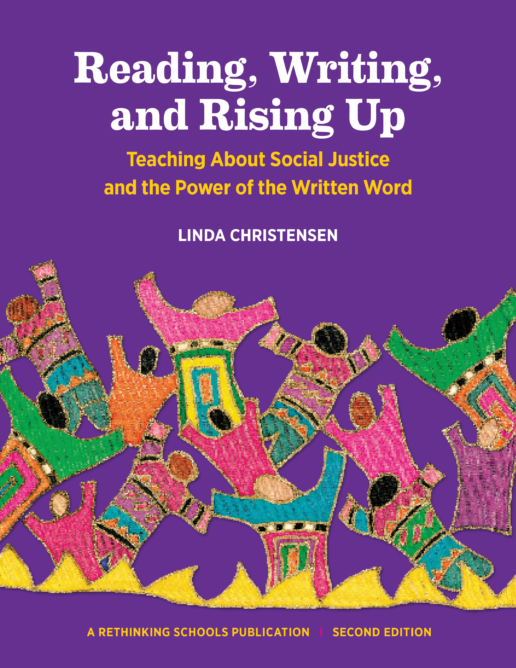
ChristensenBooks In Teaching for Joy and Justice, Linda Christensen demonstrates how she draws on students’ lives to teach poetry, essays, narratives and critical literacy skills. Reading Writing, and Rising Up is a practical, inspirational book that offers essays, lesson plans, handouts, and a remarkable collection of student writing, all rooted in an unwavering focus on language arts teaching for justice.

ScreenFreeWeekYoung children spend an average of 32 hours per week in front of screens. The number is even higher for older children. These alarming numbers provide as good a reason as any to observe Screen Free Week April 29-May 5, spearheaded by the Campaign for a Commercial Free Childhood.

If you take the challenge to turn off your screens, we commend you and encourage you to visit screenfree.org for helpful resources on how to plan your week to minimize temptation and have some screen-free fun.

But even if you can’t or won’t power down, don’t let that stop you from using Screen-Free Week to reflect upon your family’s interactions with TV and technology.

Rethinking Popular Culture and Media

Receive 15% discount until May 30. Use code SFWE13.

Elizabeth Marshall and Özlem Sensoy, editors of our extremely popular Rethinking Popular Culture and Media, wrote in an editorial two years ago, “Screen Free Week is also an opportunity to consider our relationship with media and the marketing activities that underlie them.”

They encourage us to “reconsider our relationship with our media-saturated society and to ask whether these media support or undermine the democratic values we espouse.”

Here are a few reading recommendations that will help you fine-tune your critical media literacy skills, as well as see critical examination of media in action:

Rethinking Popular Culture and Media, edited by Elizabeth Marshall and Özlem Sensoy, includes excellent articles by teachers, scholars, parents and activists who examine how and what popular TV programs, films, and other media “teach.”  We’re offering a 15% discount until May 31 with code SFWE13 when you order at our Web site.

Lesson Ideas for Screen Free Week – includes an article from Rethinking Popular Culture and Media

Power Down for Screen Free WeekThe Vancouver Sun By Özlem Sensoy and Elizabeth Marshal 14 April 2011

Schlock Proof Your Child, by Özlem Sensoy, 30 Jun 2011, TheTyee.ca 2011

A Review of ‘42’: Jackie Robinson’s Bitter Pill, by Dave Zirin.

Rethinkin’ Lincoln, by Bill Bigelow

“Ball Licky-Lickly!” Pedagogical Strategies for Interrogating Pop Culture Images, by Özlem Sensoy

Rethinking “The Lorax”, by Bill Bigelow

Saviors and Burnouts: Rethinking Teachers in Popular Culture, by Elizabeth Marshall

Children’s Literature for the 99%, by Elizabeth Marshall

Follow

Get every new post delivered to your Inbox.

Join 415 other followers

%d bloggers like this: